
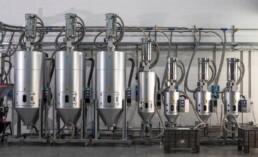
Plastic dehumidifier: what it is, what it is used for, Vismec dehumidifiers
The plastic dehumidifier plays a fundamental role in the production processes of companies involved in transformation of plastic materials.
But what exactly is it and what role does it play in this field? We will see in this article, exploring its characteristics, operation and practical applications. Finally, we will discuss the advantages of the dehumidifiers offered by Vismec.
Plastic dehumidifier: operation and applications
Plastic dryers are machines designed to eliminate the moisture in plastic granules. In fact, the presence of moisture can compromise the material features and, as a consequence, the quality of the result of plastics transformation processes.
Therefore, the use of a plastic dehumidifier becomes essential to ensure the efficiency and reliability of the production process and the quality of the final result.
The operation of dehumidifiers is based on a condensation process, which can be summarised as follows:
- Initially, the moist air contained in the plastic granules is sucked into the device. Then, the air flow passes through a series of heat exchangers, where it is cooled below its dew point.
- In this way, the moisture present in the air condenses into liquid form and can be eliminated. This process returns the granule perfectly dry, that is, in an optimal condition to be used in plastic processing.
In this production process, the use of a high-performance and reliable plastics dehumidifier brings several advantages.
- First, it helps to maintain the stability of the physical and mechanical characteristics of the polymers, avoiding alterations due to humidity.
- Consequently, it reduces the risk of defects or deformations in the finished product and the possible negative impacts on performance when such a product is used.
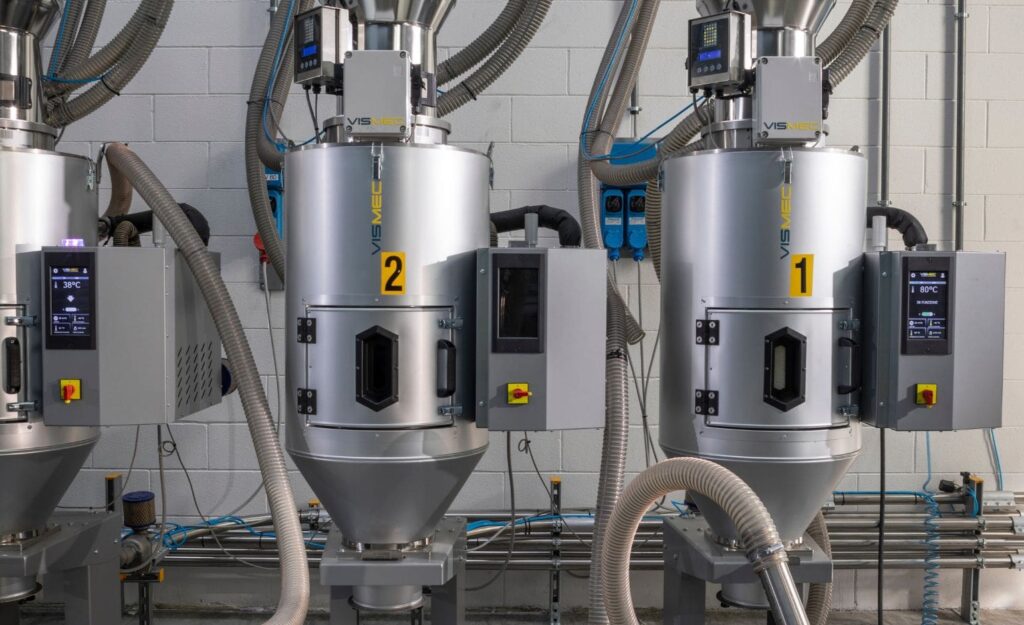
In some fields, such as medical, food or bioplastics, these characteristics are particularly important, because they are also linked to consumer health, safety of use, and maintenance of high performance standards.
Similarly, the use of optimally dehumidified polymers as raw material contributes to the good aesthetic of the finished product. This element is significant in sectors such as design, construction, production of components for consumer electronics, automotive sector.
In the next section, we will present wheel dehumidifiers produced by Vismec, and explain their features and advantages.
Vismec plastic dehumidifiers
The plastic dehumidifiers we produce provide efficient dehumidification combined with great flexibility. In addition, they save energy, reducing consumption and costs.
These advantages arise especially from the possibility of adjusting the dew point of the air flow. In fact, the operating mechanism of our machines allows calibrating the dew point, keeping it constant over time, regardless of any external ambient condition.
Each Vismec plastic granule dehumidifier adds to this feature additional adjustment, like temperature monitoring and control mechanisms. Let’s see them in particular.
- Smart Mode, that controls the temperature of the return air, automatically adapting the process to the production needs of the client company.
- MPM (Material Protection Management), that guarantees the integrity of the material, protecting it from excess dehumidification. This achievement is important to ensure maximum quality and is possible by monitoring the loading mechanism and the return air temperature.
- SLS (Safety Loading System), that prevents still wet plastic granules from reaching the production machinery, thanks to accurate control of the dehumidification time.
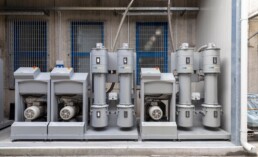
The latest proposal in the range of Vismec wheel dryer for plastics is Drycube. Drycube combines the efficiency of a rotor dehumidifier with an integrated pneumatic conveying system, a receiver for the dehumidification hopper, a receiver for IMM and all related accessories.
The conveying of hot materials takes place in a closed circuit: hot dry air is used to transport the material to the processing machine, and this particular technology allows the polymer to be kept stable away from changes in temperature and humidity from the outside air.
DryCube enables the automatic setting of the parameters of the drying process and continuously monitors the operations to achieve the ideal conditions and protect the material from over-dehumidification. It is particularly suitable as a stand-alone flexible dehumidifier to be placed on the side of the processing machine.
When the dehumidifier is positioned next to a plastics processing machine (usually a press), this mechanism allows a greater flexibility and speed of use, reducing processing times.
However, the Vismec product range for dehumidification is much broader and includes machines, control and measurement systems, and accessories. If you want to learn more and choose the most suitable solution for your company? Contact our team: we will be happy to support you.


Proportional valve: operation and advantages in conveying plastic polymers
A proportional valve is a simple mixing element. It is used in industrial automation and engineering applied to system for conveying bulk materials by means of an air flow, generally called pneumatic conveying systems. In this article we will have a closer look at what it is, its applications and the advantages of Vismec proportional valves for the conveying plastic granules.
Proportional valve: general operation
The name “proportional valve” comes from the fact that it is used to create a proportion between two different types of material. This name is improper in this field, because in engineering it is usually referred to as being a valve that is able to change the flow rate of different types of flows proportionally to the control signal received.
Thus, proportionality is understood as the relationship between the control signal which varies in a certain range of values, and the opening position which is variable in a certain range too. These devices find application in various sectors, including the automotive, aerospace, chemical and energy industries. In these areas, for example, they can be used to:
- control pressure and flow rate of fluids in hydraulic systems;
- ensure precise dosing of liquids in chemical processes and other processes;
- regulate the speed in automatic transmission systems of vehicles.
In the case of proportional valves used in pneumatic conveying, the proportion between two different materials is not achieved through a continuous variation of a valve body that continuously modulates two flows. It is, instead, achieved by the proportion between the conveying time of a first material and the conveying time of a second material.
Thus, the proportional valves produced by Vismec allow the alternating suction, in a specific proportion, of two different plastic materials through the action of an air flow. For example, it may be a virgin polymer and a regrind polymer, or two primary materials. The proportion between the two is simply set by indicating the percentage of one material compared to the other.
The versatility and precision of proportional valves make them very useful in various applications where handling of two materials belonging to the same granule receiver is required. For this reason, they are an essential component of the Vismec feeding systems for plastics processing companies.
As we will see, the valves that we design and integrate into products for conveying plastic granules have specific characteristics that make them extremely functional. However, let’s start from the beginning by briefly explaining how this type of device works in general.
The proportional valve for bulk materials operates by means of two shutters which are able to block the flow of granules and hermetically seal the duct, in response to a command or control setting. This command controls the alternating opening of the valve stems, making it possible to create a ratio between two materials arriving at the same bulk receiver.
As we have mentioned, in the case of Vismec proportional valves, the material in transit consists of polymer granules sucked alternately according to an adjustable proportion. Looking at their use in conveying polymers for plastic processing, let’s focus on the proportional valves designed by our company.
Advantages of Vismec proportional valves for conveying plastic granules
The Vismec proportional valve, installed before or in correspondence with the plastic granule receiver, allows two different types of plastic materials to be sucked in alternately thanks to an air flow produced by the same vacuum generator. The valve switches the vacuum from a main pipe to a secondary one.
From the point of view of the process control, it is sufficient to set the percentage of the second material to manage the entire process. Through the control, it is possible to vary the percentages of the two components to obtain a loading proportion. To increase homogeneity, the materials can be alternated several times during the same loading cycle.
Let's have a look at the features that make VISMEC proportional valves unique on the market.
- The extremely clean one-piece precision-cast stainless steel design avoids the presence of stagnation areas. Therefore, the passage of granules is fluid and without interruptions or deposits. The stainless steel body greatly reduces wear due to abrasion caused by sliding granular materials.
- The inspection window is made of borsilicate glass that can withstand temperature changes and is wear-resistant to impacts of granules. The window has gaskets made of elastomers and noble polymers with high temperature resistance that are not in contact with the granules .
- The valve is controlled by a Vismec receiver and does not need a separate stand-alone control. Once the receiver has been properly parameterised, the valve is also adjusted accordingly, without the need for additional control points.
- The shut-off system consists of two stainless steel double-stage shutters, in which the first stage stops the granules and the second stage seals the pipe to enable the perfect transfer of vacuum into the second pipe. There are also moulded elastomer wear-resistant gaskets without frontal impact, to allow a perfect seal.
- The proportional valve is part of a pneumatic conveying system for polymer granules or for granules dehumidification and conveying. This plant is controlled by a system that uses the standard OPC UA protocol, allowing the automated management of processes with an advanced and intuitive human-machine interface.
Let’s now see the advantages of the proportional valve.
- Simple adjustment. The device allows you an easy adjustment of two different materials to be used on the same polymer processing machine. This element is particularly useful when it comes to ensure an accurate proportion of materials in transit, as in the case of Vismec proportional valves.
- Wear-resistance. This type of valve is designed and manufactured to withstand wear and weather conditions. Consequently, it ensures a long operating life and reliable operation over time.
- Presence of control and signalling systems that facilitate the use of the device.
- Perfect closure of the valve and connecting components to avoid inefficiencies.
As we have seen, the Vismec proportional valves allow you to manage different functions and passages within the systems in a simple, rapid and automated way by a single control point. So, they allow companies that use them to simplify operations, optimise time and reduce consumption.
If you want to know in detail how they work and the other Vismec proposals for feeding and conveying plastic polymers, contact our team. We will be happy to evaluate with you the most suitable solutions for your company.
Gravimetric doser and volumetric doser: features and applications
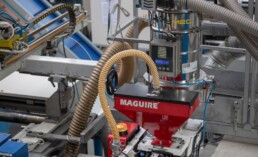
The gravimetric doser and the volumetric doser are devices used in the industrial sector for the precise measurement and dosing of powders or granules.
The two tools differ significantly in their measuring methods and in their possible applications. We are going to talk about it in this article, also presenting the solutions proposed by Vismec for gravimetric and volumetric dosing.
Gravimetric doser and volumetric doser
So let’s start by trying to understand what the two devices are and presenting the differences between the gravimetric and volumetric dosers.
In the dosing process, the gravimetric doser measures the quantity of material by weight, thanks to an integrated scale that continuously measures the weight of the material.
Consequently:
- doser weighs the material in real time and in a highly accurate way;
- device compensates for any variations in the density of the weighted material or environmental conditions;
- this precision is crucial in sectors such as the chemical, pharmaceutical and food industries, where the correct dosing of ingredients is essential for the quality of the final product.
Even in applications in the plastics processing sector which requires a high precision, the gravimetric blender ensures quality results. An example? The dosing of additives.
Instead, the volumetric dosing unit doses the material based on the occupied volume. This type of doser often uses a system of measuring chambers or tanks that fill and empty cyclically, dispensing a pre-established amount of material.
Volumetric dosers are often faster than gravimetric dosers, but can be less accurate because they do not take into account variations in material density. As we will see in the next paragraph, the volumetric dosers that our company offers, on the other hand, allow the dosing of plastic granules while maintaining precision.
A further difference between the two dosing systems concerns the calibration of the instrument:
- the gravimetric doser requires accurate initial calibration to ensure the accuracy of results over time;
- in the case of the volumetric doser, adjustments must be more frequent because the density of the material may vary.
Additionally, gravimetric blenders are more suitable for materials that may compact or have a significant change in density during production.
Thus, the two types of blenders have different operating methods. Vismec offers advanced and effective solutions for gravimetric and volumetric dosing, calibrated according to:
- type of application;
- supported plastic processing;
- characteristics of the use environment.
We will present them more thoroughly in the next paragraph.
Products offered by Vismec for volumetric and gravimetric dosing
As we were saying, Vismec volumetric and gravimetric dosers allow accurate dosing of plastic granules and any additives. Each product has its own specific features, designed to best meet the needs of customer companies.
- The MGF gravimetric doser accurately measures the quantity of blended additive with the plastic material. The dosing unit features a high-precision automatic recalibration system, without the need for additional configurations.
- The WSB series doser is equipped with advanced control technology that allows accurate and real-time monitored mixing of the granules. The device fits on any moulding machine, even allowing the loading time of the plastic material to be adjusted.
- Vismec volumetric dosers are also designed to support plastic injection or extrusion moulding machinery. The device is designed to withstand mechanical stress and vibration without compromising the precision of operations. In addition, the loss-in-weight volumetric dosing system allows the weight of the polymers to be constantly monitored, ensuring the optimum quality of the end result.
All products offered by Vismec for gravimetric and volumetric dosing, in addition to precision, have a common ability to facilitate machine maintenance and cleaning. Furthermore, the integrated control devices optimise dosing operations and allow the customer company to reduce material waste and associated costs.
Would you like to learn more about the dosing systems and other products Vismec offers companies in the plastics sector for polymer dehumidification, conveying and storage operations? Contact our team and tell us what you need. Together we will find the most effective solution for your company.
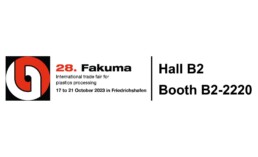
Vismec at Fakuma 2023, the International Trade Fair for Plastics Processing: 17 - 21 October, Friedrichshafen
From 17 to 21 October 2023, Vismec will take part in Fakuma, one of the world's largest trade fairs for plastics processing companies. The event, now in its 28th year, will take place as usual in Friedrichshafen, Germany.
About Fakuma
Fakuma is one of the largest international trade fairs in the plastics processing industry. This year, the event will attract more than 1,500 exhibitors to Friedrichshafen, a southern German town on the shores of Lake Constance.
Among the participants will be plastics processing enterprises, service providers and companies that, like us, produce machinery and auxiliary technologies for the sector.
Vismec will be exhibit at Fakuma 2023 in Hall B2, Booth B2 - 2220. For our company, taking part in the event means having the opportunity to present its products, especially the most innovative ones, in a market that is evolving ever more rapidly.
As an evidence of this, here you are some of the main topics that well be debated in conferences and conventions during the fair
- The challenge of digitisation and man-machine interconnection systems: such as the OPC UA protocol devices integrated in Vismec machines.
- Circular economy and the reuse of production waste.
- Energy saving: an increasingly topical issue for environmental and economic reasons. From this point of view, all our products are designed and manufactured to maximize energy efficiency.
Vismec, therefore, is preparing for Fakuma 2023 with the aim of presenting machinery and devices that, due to their features, perfectly match with current trends and market demands.
Vismec objectives for Fakuma 2023
For our company this is a debut: our first participation in the Friedrichshafen exhibition. Companies in the plastic processing sector, however, already know Vismec machinery and solutions as innovative, consumes-efficient and able to ensure high quality end results.
At Fakuma 2023 we want to focus on:
- Our individual or centralised conveying systems. A range of solutions for the automatic conveying and distribution of plastic granules: complete, flexible and adapted to the different needs of companies.
- FW50, the control system connected to a Vismec 4.0 supervision device. In the new version, the FW 50 is equipped with a touchscreen display that makes interaction between the machine and the operator even easier.
Thanks to our participation to the trade fair, we plan to meet companies to work with as a partner, giving birth to new collaborations.
Moreover, Fakuma 2023 will also be an opportunity for Vismec to grasp the trends in our sector and the new market developments, and discuss them with enterprises and experts. A valuable motivation for those who, like us, want to make a difference every day.
Would you like to learn more about Vismec and its most innovative products? Contact us or visit us at the fair: we look forward to seeing you in Friedrichshafen from 17 to 21 October, Hall B2, Booth B2 - 2220.
Cyclonic filter: features and benefits
What is the cyclonic filter, and what benefits does its use entail in the vacuum transport phase of granules and plastic material? Let’s see it in this article, where we also present the applications and advantages of the cyclonic filter used in Vismec conveying systems.
Cyclonic filter: how it works
Pneumatic conveying of plastic granules can take place either under pressure or in vacuum. In vacuum conveying systems, a depression is created inside the duct through which the plastic material passes. In this way, the pressure difference generates an air flow that vacuums the granules and conveys them toward their intended destination.
In this type of system, the cyclonic filter that separates the plastic particles from the air used for transport plays a fundamental role. In summary, it operates in the following way.
- Suction of the granules: as we have seen, the granules are attracted by the air flow that is created by the pressure difference: in this way, the transport process begins.
- Creation of the vortex: a vortex is created inside the cyclonic filter, due to the centrifugal force to which the air flow and the transported material are subjected.
- Separation of particles: thanks to centrifugal force, the plastic granules separate from the air flow, which is then expelled.
This system has the advantage of avoiding any contact with outside air and makes the process contamination-free. So, cyclonic filter pneumatic vacuum conveying is also used in the pharmaceutical, food and chemical sectors, as well as, of course, in the conveying of plastic granules.
Advantages of the cyclonic filter in Vismec systems
The advantages of the cyclonic filter in this type of mechanism are more than one. Let us see them all.
- Separation efficiency: thanks to its structure and its physical mechanism of operation, the cyclonic filter allows plastic granules to be separated from the air flow very effectively.
- Robustness: the filters are designed and constructed to resist over time the continuous stresses arising from the activity of transport. In fact, this activity is very frequent and almost uninterrupted in the plastics processing sector.
- Ease of maintenance: maintenance of the cyclonic filter is relatively undemanding and does not require much time or specialised operations. In fact, it is usually limited to periodic cleaning of the internal walls to ensure optimal performance is maintained.
- Adaptability: the filters, and in general the entire vacuum conveying system, can be customised to meet the specific needs of different plastics processing companies.
The last point is one of the advantages of the cyclonic filter vacuum conveying units produced by Vismec. In fact, our systems can be customised in different configurations, even for long distance conveying.
But let us also look at the additional advantages of Vismec vacuum units.
- Big attention to correct filter sizing. Unlike other more compact products, the double and triple stage cyclonic filters that we produce and integrate into our conveying systems are sized extremely precisely, depending on the application. For this reason, they guarantee better process efficiency.
- Double filter with automatic exchange system Vismec filters can be supplemented by an additional back-up filter. The operating mechanism allows switching to the secondary filter with an automatic exchange system whenever the detection sensor signals this as necessary. A safety mechanism gives continuity to the transport phase, avoiding blockages, downtime and consequent delays.
- Easy cleaning: in Vismec vacuum conveying systems, filter cleaning is also automatic. This further reduces maintenance time and costs.
Therefore, the use of the cyclonic filter in vacuum conveying systems for plastic granules enables more efficient and optimised feeding. The benefits? Improved process quality, reduced inefficiencies and a better ratio between investment and end result.
Are you a company operating in the plastics processing sector? Contact the Vismec team to learn about all the benefits of our vacuum conveying units. Find out how we can adapt them to the needs of your company and your production processes.
Bioplastics: what they are, applications, Vismec equipment for industry
Do you know what Bioplastics are? Bioplastics are an increasingly popular sustainable alternative to traditional plastics. Coming from natural sources, they have characteristics comparable to those of normal plastics used in production processes, but have a reduced environmental impact.
Due to its features, this type of material allows for quite wide applications, including innovative sectors such as medical, 3D printing and green technologies.
What are bioplastics?
To better understand the definition of bioplastics, let us start with their origin. These are polymers produced using biodegradable or renewable raw materials, such as corn starch, sugar cane, potatoes or algae.
Bioplastics are less harmful to the environment and contribute to the reduction of CO2 emissions. Plus, of course, they reduce the production, use and consumption of plastic globally. Let us take a look at their main characteristics:
- Biodegradability: bioplastics decompose spontaneously through biological processes. Therefore, they do not contribute to the accumulation of plastic waste in the environment. In addition, they can be disposed of in a more sustainable way.
- Production from renewable raw materials: bioplastics are produced using plant-based raw materials that can be grown again and thus are available on a long-term basis.
- Reduction of CO2 emissions: in their production process, bioplastics generate far less CO2 than petroleum-derived plastics.
- Flexibility: bioplastics have different properties. Rigidity, elasticity or resistance, for example, are more or less common characteristics depending on the requirements of use.
Therefore, bioplastics represent a sustainable and innovative solution for the production of plastic materials. In the next section, we will talk about their applications and the advantages and disadvantages of their use.
Bioplastics: examples, disadvantages and advantages
Presenting some examples of bioplastics and some of their applications is the best way to explain what they are and why they are growing in popularity. Among the best-known types are:
- Polylactic acid (PLA), a bioplastic made from corn starch used to produce bottles, food packaging, caps and containers;
- Green polyethylene, derived from sugar cane, it is used for bags, films and containers;
- Polyhydroxyalkanoates (PHA), bioplastics made from vegetable oils and sugars, which find application in areas such as packaging, medicine, cosmetics and agriculture;
- Polybutylene succinate (PBS), used to produce biodegradable bags, films and packaging materials;
- Polycaprolactone (PCL), that finds application in packaging and 3D printing. It is also used for medical applications, e.g. for resorbable sutures;
- Mater-Bi, 100% compostable, is used to produce shopping bags, packaging and protective films and disposable tableware.
We have already talked about the main benefits of bioplastics in terms of sustainability, versatility and their use in highly innovative sectors.
The disadvantages, on the other hand have to do mainly with three elements:
- availability of raw materials, that is large-scale production of bioplastics requires a significant amount of plant raw materials;
- complex production processes, due to the expensive chemical and biotechnological processes for the transformation of green raw materials into bioplastics;
- composting, since some bioplastics need a controlled environment to degrade properly.
However, more and more companies are using this type of material in plastics processing. To meet their needs, Vismec has developed specific technologies and machinery.
Vismec equipment for the bioplastics sector
Our company offers a line of dryers designed specifically for all those materials that, due to their characteristics, must be treated at temperatures between 35°C and 50°C.
This innovation is dedicated to specific sectors, which we are going to examine right now.
- The bioplastics field which we are talking about this article: biological polymers that cannot be dehumidified at high temperatures. In fact, during the process, this type of material could melt or undergo degradation that would alter its characteristics and functionality.
- Materials that, subjected to high temperatures, release oils or volatile substances with a negative impact on the end result of the process.
Our low-temperature dehumidifiers work in a similar way to Vismec rotor dryers. However, to each dehumidifier we add an air/air heat exchanger located before the heating chamber. This includes a series of fans that lower the temperature of the air used to dehumidify the plastic granules.
Available in different sizes and integrable with additional accessories, our low-temperature dryers are reliable, versatile and efficient.
Would you like to know more about the features of Vismec's equipment offered to companies in the bioplastics sector? Contact us: our technicians will provide you with all the necessary specifications.

Vismec presents Vistouch
Vismec is proud to present VisTouch: the simple and intuitive system to control Vismec wheel dryers series DW (DryWell) and DP (DryPlus).
Finally, the drying data all at a glance!
Learn more about VisTouch here.


Pneumatic conveying of plastic granules: what it is, advantages, Vismec solutions
Pneumatic conveying of plastic granules: what is it, how does it work and what are its applications? We are going to talk about it in this article, also introducing all the advantages of Vismec conveying systems for plastics processors.
Pneumatic conveying of plastic granules: what is it?
Pneumatic conveying of plastic granules is an efficient and advanced system for the fast and safe transfer of polymers in different processing steps. This method, which uses compressed air, creates a flow that is pushing granules through pipes and ducts.
The pneumatic conveying process, also called feeding, takes place through systems that integrate different technologies and equipment. We will see this in more detail in the next section, in which we will present the Vismec conveying systems. However, let us anticipate that pneumatic conveying of granules offers several advantages compared to other methods, such as mechanical conveying. For example:
- fast and continuous movement of materials without the need for complex operations or production interruptions;
- greater control over the speed and quantity of material conveyed, enabling a more accurate and reliable dosing process;
- reduced waste and more efficient waste material management;
- pneumatic conveying in an enclosed environment, with reduced risk of external contamination.
These characteristics make this feeding method perfect for many sectors, especially those with specific quality, safety and efficiency requirements.
A prime example is the granulation of residual material from processing. In this process, plastic waste is ground into granules and then transported to the melting or extrusion machines, without waste.
The pneumatic conveying of plastic granules is also used in other industrial sectors, such as the production of containers or other products for the medical and pharmaceutical sectors. In fact, in these areas, feeding in a closed environment is ideal for maintaining the integrity of the material conveyed, avoiding contamination or alteration of its characteristics.
Thus, pneumatic conveying systems, as we have seen, represent an advanced and highly efficient method of handling that offers many advantages. This is precisely why, among the auxiliary machinery that Vismec proposes to plastics processors, there are also various pneumatic granule conveying systems.
Vismec pneumatic conveying systems
In the range of feeding systems and components for plastic granule conveying systems we offer:
- vacuum systems with side channel blowers, available in various configurations;
- receivers with various load capacities;
- automatic manifold that make the feeding phase fully automated;
- efficient and accurate self-learning weighing systems, such as the Halo weighing ring;
- duct cleaning valves and dedusters, to guarantee perfect plant efficiency and the best quality of the final product.
Our feeding and conveying machines and systems enable the automatic distribution of plastic material efficiently and effectively, through individual or centralised control systems integrated with OPC UA protocol. These include the Vismec FW50, capable of handling up to 48 transport stations, depending on the company’s requirements.
The advantages that our pneumatic conveying systems offer companies are many. Let’s see all.
- Energy efficiency: Vismec solutions are designed and manufactured for maximum energy efficiency, reducing consumption and costs.
- Complete traceability of the plastic granule, resulting in reduced processing waste and associated costs;
- High quality results, thanks to the attention we pay to each individual component and its functional integration within the machinery or plant. An example? The dedusting systems we have just mentioned. In fact, our dedusting systems are used in high-tech production, such as in the optical sector, where the perfect cleanliness of lenses, optical covers and other surfaces is a basic condition.
- Flexibility: we calibrate machinery and systems for the pneumatic transport of plastic granules according to customer requirements. In fact, Vismec products are available in different configurations, sizes and materials, depending on the field of application and the production layout in which they will be inserted.
If you would like to learn more about our granule conveying equipment and the most suitable applications for your company, please contact us and talk to our technicians: the Vismec team will be happy to help you.

Plastics processing: all about it and Vismec solutions
The term “plastics processing" refers to the various industrial processes that allow plastic materials to be transformed into products, objects and components.
Thus, the processing of plastic materials is a key activity in the production of goods. This is why it is important to manage it with efficient, high-performance and safe solutions and machinery.
So this article presents the main processing operations and gives an overview of the different solutions that Vismec offers plastic processors.
1: Moulding
One of the most common techniques used is moulding. The process begins with melting plastic material, placing it in a mould and applying properly calibrated pressure to make the finished product.
The most common types of moulding include:
- Injection, during which the plastic material is injected into the mould to create the desired shape;
- extrusion, where a molten plastic wire is passed through a shaped mould to create long sections of constant shape, such as pipes or plastic bars;
- rotational, the process of rotating a mould to create hollow, spherical or cylindrical shapes that do not require further welding.
2: Extrusion
Another popular technique in the field of plastics processing is extrusion.
This is a continuous process that uses a press to force suitably heated and melted plastic material through a specially shaped duct called 'head' or supply chain.
The material expands and takes the desired shape, before being cooled. This is achieved by using:
- flat heads to make sheets, plastic plates and films;
- ring heads to produce tubes and tubular films;
- shaped heads for geometric profiles and joints.
In other words, the shape of the head varies depending on the type of result desired and the final application. Extrusion is often used to create thermoplastic tubes, sheets, joints and profiles.
3: Blowing
Blowing is a plastic processing technique used to make three-dimensional objects such as bottles and containers.
The process takes place in several steps:
- plastic granules are melted in a heated cylinder, resulting in a tubular plastic pre-mould;
- tube is inserted into a mould shapes as the finished product;
- air is blown into the mould to make the plastic adhere to its walls;
- material is kept into the mould until it has cooled and hardened. After that, the mould is opened to release the finished shape.
Vismec offers a wide range of machinery designed for plastic processing companies. Especially, our products are designed to make moulding, extrusion and blow moulding processes more efficient. We offer solutions for:
- energy saving drying of plastic granules;
- automatic polymers conveying and feeding;
- precise dosing of plastic material during mixing;
- grinding of plastic processing waste;
- material storage.
In addition to these processes, for which Vismec offers tailor-made advanced solutions, there are other plastic processes. Let us look at them together.
4: Thermoforming
With the thermoforming technique, heat is applied to a sheet of plastic material, making it malleable.
Once ready, the sheet is placed over a mould that is set for the final shape of the product and then subjected to calibrated pressure to create the desired object.
Thermoforming is commonly used to produce packaging (e.g. food containers), toys and decorations.
5: Calendering
Calendering is a technique used in the processing of rigid materials such as PVC: it applies heat and pressure to a rigid sheet to make it malleable.
Once this first part of the process is completed, the sheet is rolled and formed to the desired shape.
Calendering is used to make flooring, fixtures, wall coverings, roofing and technical textiles.
6: Hot bending
Hot bending is another technique for processing plastic sheets. The sheet, previously cut, is heated at a high temperature. Once a specific heat point is reached, the material can be bent or shaped. This process is widely used in the production of signs and poster materials.
Vismec machinery supporting plastic moulding, extrusion and blow moulding processes offers several benefits to companies in this sector. These include:
- energy savings;
- reduction of waste and costs through traceability;
- increased efficiency and productivity.
If you want to know more, contact us. We will help you choose the best machinery for your business.

OPC UA Protocol: all about it and the benefits for your business
The OPC UA protocol is an important evolution in the field of industrial automation and communication among devices. In this article we are going to introduce its features, advantages and practical applications in Vismec machines.
OPC UA protocol: characteristics
The acronym OPC UA stands for Open Platform Communications Unified Architecture and indicates a standard created to manage the continuous flow of information among non-homogeneous devices. In particular, the OPC UA protocol is one of the main systems for ensuring data interoperability in advanced industrial automation, the so-called Industry 4.0.
Thanks to this protocol, industrial machinery dialogues with the management system of manufacturing companies, enabling the automated organisation and management of production processes and making work easier and faster.
The rules and technical specifications encoded in OPC UA allow the different components of automated systems to communicate with each other, without requiring the development of customised codes to handle complex situations.
Thus, devices and applications from different manufacturers can share data regardless of the platform or programming language they use. This simplifies the integration of new devices and the upgrade of existing systems, reducing costs and increasing efficiency. Everything is done through an intuitive and user-friendly human-machine interface according to the principles of Industry 4.0.
Benefits for automation
The OPC UA standard is used in many sectors, from classic manufacturing industries to advanced industrial automation and medical sectors. As we said, it has been created to ensure interoperability between devices and control systems by providing a standardised communication protocol.
Among the advantages of the OPC UA protocol:
- advanced security, that is OPC UA provides robust security features to protect data shared between devices. In particular, it uses end-to-end encryption, certificate-based authentication and digital signature mechanisms to ensure integrity and privacy. This is particularly important in industrial automation, where data protection and access control are crucial to avoid security breaches.
- scalability and flexibility, which means that OPC UA is highly scalable and can be used in networks of any size, from small local installations to large infrastructures spread across multiple sites. In addition, it is suitable for different industries and for use on multiple devices: PCs, servers, mobile technologies and even embedded devices.
- advanced data management, that is OPC UA has powerful tools for managing data. Its functionalities allow, for example, real-time publishing, historical storage, alarm information and past malfunctions storage.
- open standards, that means that OPC UA is a protocol based on open source standards. This allows it to be integrated with systems such as SCADA, MES (Manufacturing Execution Systems) and others, enabling an uninterrupted flow of information among the different levels of automation.
The OPC UA protocol also allows production monitoring and analysis. Thus, in addition to the benefits in terms of automation, user friendliness, increased productivity and time reduction, companies also have access to useful, up-to-date information for making decisions and optimising operations.
Given these characteristics and the benefits it offers companies, Vismec decided to integrate the OPC UA standard in all its machines.
Applications of the OPC UA standard in Vismec machines
The integration of the OPC UA standard in Vismec machines is carried out through a plug and play system. This means that operator intervention during initial operation is very minimal: there is no need for detailed knowledge of the hardware or manual installation.
As we have seen, the protocol allows the production system to be controlled and supervised from a single control point. From the management system, whoever controls production (or a phase of the production process) inputs an order to the system, which the machines execute automatically.
Through OPC UA protocols, it is possible to:
- activate the machines involved in the different processes, as conveying, volumetric and gravimetric dosing, drying, grinding and storage;
- set the correct parameters, such as temperature, dew point, flow rate, load and others;
- obtain data on production efficiency in order to better organise it.
An example? Vismec FW 50, a control system that manages up to 48 conveying stations per empty line with a possible emergency reserve system.
All components are connected internally via VisiBus protocol and externally via the universal OPC UA interface. The FW50 control also has an user-friendly display and provides for connection to the Vismec 4.0 supervisory system.
Would you like to discover the advantages of the OPC UA protocol integrated in Vismec products and understand how to apply it to your company’s production and management system? Contact us: we are at your disposal.