

Vismec presents Vistouch
Vismec is proud to present VisTouch: the simple and intuitive system to control Vismec wheel dryers series DW (DryWell) and DP (DryPlus).
Finally, the drying data all at a glance!
Learn more about VisTouch here.


Pneumatic conveying of plastic granules: what it is, advantages, Vismec solutions
Pneumatic conveying of plastic granules: what is it, how does it work and what are its applications? We are going to talk about it in this article, also introducing all the advantages of Vismec conveying systems for plastics processors.
Pneumatic conveying of plastic granules: what is it?
Pneumatic conveying of plastic granules is an efficient and advanced system for the fast and safe transfer of polymers in different processing steps. This method, which uses compressed air, creates a flow that is pushing granules through pipes and ducts.
The pneumatic conveying process, also called feeding, takes place through systems that integrate different technologies and equipment. We will see this in more detail in the next section, in which we will present the Vismec conveying systems. However, let us anticipate that pneumatic conveying of granules offers several advantages compared to other methods, such as mechanical conveying. For example:
- fast and continuous movement of materials without the need for complex operations or production interruptions;
- greater control over the speed and quantity of material conveyed, enabling a more accurate and reliable dosing process;
- reduced waste and more efficient waste material management;
- pneumatic conveying in an enclosed environment, with reduced risk of external contamination.
These characteristics make this feeding method perfect for many sectors, especially those with specific quality, safety and efficiency requirements.
A prime example is the granulation of residual material from processing. In this process, plastic waste is ground into granules and then transported to the melting or extrusion machines, without waste.
The pneumatic conveying of plastic granules is also used in other industrial sectors, such as the production of containers or other products for the medical and pharmaceutical sectors. In fact, in these areas, feeding in a closed environment is ideal for maintaining the integrity of the material conveyed, avoiding contamination or alteration of its characteristics.
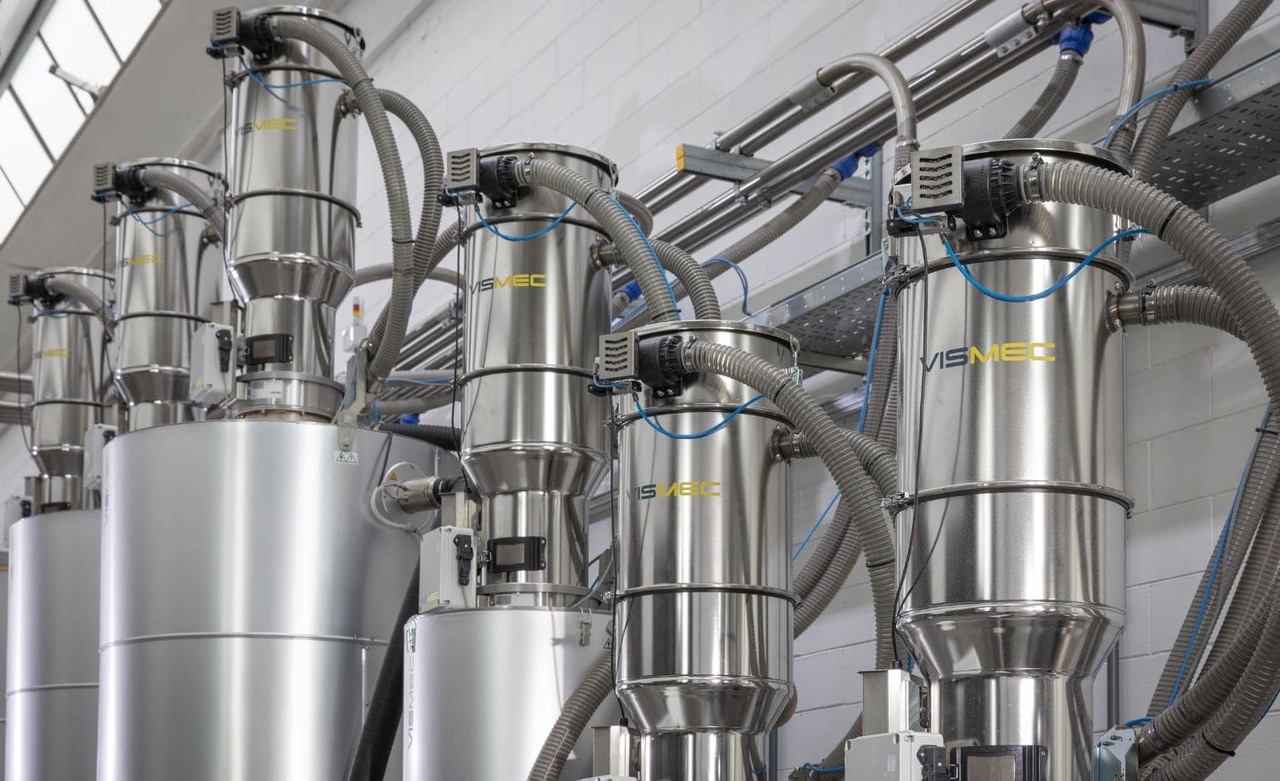
Thus, pneumatic conveying systems, as we have seen, represent an advanced and highly efficient method of handling that offers many advantages. This is precisely why, among the auxiliary machinery that Vismec proposes to plastics processors, there are also various pneumatic granule conveying systems.
Vismec pneumatic conveying systems
In the range of feeding systems and components for plastic granule conveying systems we offer:
- vacuum systems with side channel blowers, available in various configurations;
- receivers with various load capacities;
- automatic manifold that make the feeding phase fully automated;
- efficient and accurate self-learning weighing systems, such as the Halo weighing ring;
- duct cleaning valves and dedusters, to guarantee perfect plant efficiency and the best quality of the final product.
Our feeding and conveying machines and systems enable the automatic distribution of plastic material efficiently and effectively, through individual or centralised control systems integrated with OPC UA protocol. These include the Vismec FW50, capable of handling up to 48 transport stations, depending on the company’s requirements.
The advantages that our pneumatic conveying systems offer companies are many. Let’s see all.
- Energy efficiency: Vismec solutions are designed and manufactured for maximum energy efficiency, reducing consumption and costs.
- Complete traceability of the plastic granule, resulting in reduced processing waste and associated costs;
- High quality results, thanks to the attention we pay to each individual component and its functional integration within the machinery or plant. An example? The dedusting systems we have just mentioned. In fact, our dedusting systems are used in high-tech production, such as in the optical sector, where the perfect cleanliness of lenses, optical covers and other surfaces is a basic condition.
- Flexibility: we calibrate machinery and systems for the pneumatic transport of plastic granules according to customer requirements. In fact, Vismec products are available in different configurations, sizes and materials, depending on the field of application and the production layout in which they will be inserted.
If you would like to learn more about our granule conveying equipment and the most suitable applications for your company, please contact us and talk to our technicians: the Vismec team will be happy to help you.
Plastics processing: all about it and Vismec solutions
The term “plastics processing" refers to the various industrial processes that allow plastic materials to be transformed into products, objects and components.
Thus, the processing of plastic materials is a key activity in the production of goods. This is why it is important to manage it with efficient, high-performance and safe solutions and machinery.
So this article presents the main processing operations and gives an overview of the different solutions that Vismec offers plastic processors.
1: Moulding
One of the most common techniques used is moulding. The process begins with melting plastic material, placing it in a mould and applying properly calibrated pressure to make the finished product.
The most common types of moulding include:
- Injection, during which the plastic material is injected into the mould to create the desired shape;
- extrusion, where a molten plastic wire is passed through a shaped mould to create long sections of constant shape, such as pipes or plastic bars;
- rotational, the process of rotating a mould to create hollow, spherical or cylindrical shapes that do not require further welding.
2: Extrusion
Another popular technique in the field of plastics processing is extrusion.
This is a continuous process that uses a press to force suitably heated and melted plastic material through a specially shaped duct called 'head' or supply chain.
The material expands and takes the desired shape, before being cooled. This is achieved by using:
- flat heads to make sheets, plastic plates and films;
- ring heads to produce tubes and tubular films;
- shaped heads for geometric profiles and joints.
In other words, the shape of the head varies depending on the type of result desired and the final application. Extrusion is often used to create thermoplastic tubes, sheets, joints and profiles.
3: Blowing
Blowing is a plastic processing technique used to make three-dimensional objects such as bottles and containers.
The process takes place in several steps:
- plastic granules are melted in a heated cylinder, resulting in a tubular plastic pre-mould;
- tube is inserted into a mould shapes as the finished product;
- air is blown into the mould to make the plastic adhere to its walls;
- material is kept into the mould until it has cooled and hardened. After that, the mould is opened to release the finished shape.
Vismec offers a wide range of machinery designed for plastic processing companies. Especially, our products are designed to make moulding, extrusion and blow moulding processes more efficient. We offer solutions for:
- energy saving drying of plastic granules;
- automatic polymers conveying and feeding;
- precise dosing of plastic material during mixing;
- grinding of plastic processing waste;
- material storage.
In addition to these processes, for which Vismec offers tailor-made advanced solutions, there are other plastic processes. Let us look at them together.
4: Thermoforming
With the thermoforming technique, heat is applied to a sheet of plastic material, making it malleable.
Once ready, the sheet is placed over a mould that is set for the final shape of the product and then subjected to calibrated pressure to create the desired object.
Thermoforming is commonly used to produce packaging (e.g. food containers), toys and decorations.
5: Calendering
Calendering is a technique used in the processing of rigid materials such as PVC: it applies heat and pressure to a rigid sheet to make it malleable.
Once this first part of the process is completed, the sheet is rolled and formed to the desired shape.
Calendering is used to make flooring, fixtures, wall coverings, roofing and technical textiles.
6: Hot bending
Hot bending is another technique for processing plastic sheets. The sheet, previously cut, is heated at a high temperature. Once a specific heat point is reached, the material can be bent or shaped. This process is widely used in the production of signs and poster materials.
Vismec machinery supporting plastic moulding, extrusion and blow moulding processes offers several benefits to companies in this sector. These include:
- energy savings;
- reduction of waste and costs through traceability;
- increased efficiency and productivity.
If you want to know more, contact us. We will help you choose the best machinery for your business.